Luenberger 观测器
龙伯格观测器(Luenberger Observer)是一种典型的全维观测器。
连续形式
考虑连续线性系统
\[\begin{aligned}
\dot{\mathbf{x}} &= A\mathbf{x}+B\mathbf{u}\\
\mathbf{y} &= C\mathbf{x} + D\mathbf{u}
\end{aligned}\]
用 \(\hat{\mathbf{x}}\) 和 \(\hat{\mathbf{y}}\) 分别表示状态量和输出量的观测值,则有最简单的开环状态估计器:
\[\begin{aligned}
\dot{\hat{\mathbf{x}}} &= A\hat{\mathbf{x}}+B\mathbf{u}\\
\hat{\mathbf{y}} &= C\hat{\mathbf{x}} + D\mathbf{u}
\end{aligned}\]
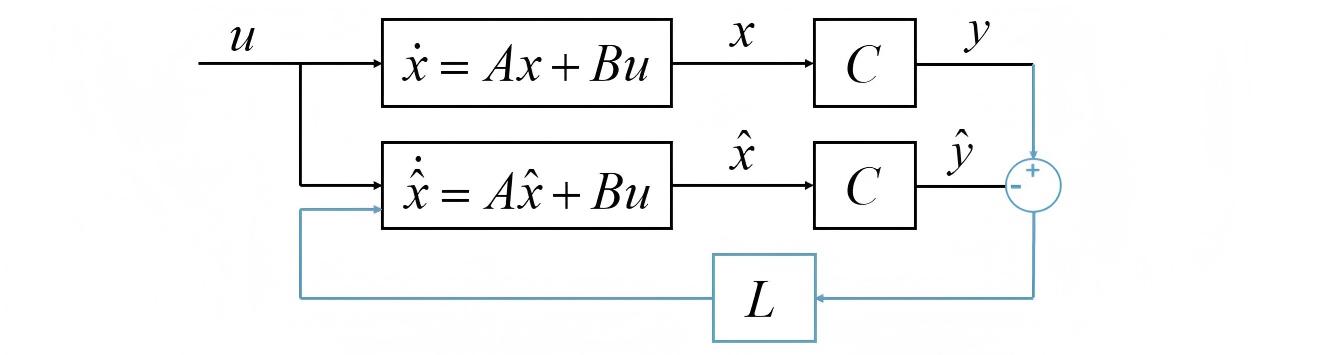
由于系统状态初值 \(\mathbf{x}_0\) 往往难以获得,开环观测器必定存在误差。考虑将其扩展成闭环形式:
\[\begin{aligned}
\dot{\hat{\mathbf{x}}} &= A\hat{\mathbf{x}}+B\mathbf{u}+L(\mathbf{y}-\hat{\mathbf{y}})\\
\hat{\mathbf{y}} &= C\hat{\mathbf{x}} + D\mathbf{u}
\end{aligned}\]
以上就是针对连续线性系统的龙伯格观测器形式,其中 \(L\) 是可调整的增益矩阵。
增益矩阵取值
我们接下来讨论,连续线性系统的龙伯格观测器的增益矩阵 \(L\) 需满足何种条件,才能使得观测结果收敛至真值。
用 \(\tilde{\mathbf{x}} = \mathbf{x}-\hat{\mathbf{x}}\) 表示状态量的观测误差,有
\[\begin{aligned}
\dot{\tilde{\mathbf{x}}} &= A\mathbf{x}+B\mathbf{u}-A\hat{\mathbf{x}}-B\mathbf{u}-L(\mathbf{y}-\hat{\mathbf{y}})\\
&= A\tilde{\mathbf{x}}-LC\tilde{\mathbf{x}}\\
&= (A-LC)\tilde{\mathbf{x}}
\end{aligned}\]
因此,当系统能观时,只需要选择合适的增益矩阵 \(L\) 使得 \(A-LC\) 的所有特征值均具有负实部,即可保证 \(\tilde{\mathbf{x}}\rightarrow \mathbf{0}\) 。
离散形式
根据 微分方程的离散化 对连续系统进行采样周期 \(T_s\) 的精确离散化,得到
\[\begin{aligned}
\mathbf{x}[k+1]&=A_d\mathbf{x}[k]+B_d\mathbf{u}[k]\\
\mathbf{y}[k]&=C\mathbf{x}[k]+D\mathbf{u}[k]
\end{aligned}\]
其中,
\[A_d = e^{AT_s},B_d=\int_{0}^{T_s} e^{As}B\mathrm{d}s.\]
从而有龙伯格观测器的离散形式:
\[\begin{aligned}
\hat{\mathbf{x}}[k+1] &= A_d\hat{\mathbf{x}}[k]+B_d\mathbf{u}[k]+L_d(\mathbf{y}[k]-\hat{\mathbf{y}}[k])\\
&= A_d\hat{\mathbf{x}}[k]+B_d\mathbf{u}[k]+L_d(\mathbf{y}[k]-C\hat{\mathbf{x}}[k]-D\mathbf{u}[k])
\end{aligned}\]